
 The crypto hiring landscape has hit a professional inflection point. We are moving away from the era of growth at all costs toward a market that prioritizes operational resilience. The most obvious indicator? The major institutional infrastructure deals are no longer happening over Discord at 1 AM. Instead they are being closed in boardrooms across New York City.
For years, the digital asset ecosystem prided itself on being entirely decentralized and location-agnostic. But as the market matures through a rigorous structural clean-out, the center of gravity has fundamentally moved. The market now rewards reliability, compliance, settlement, and institutional execution.
The Macro Shift: Infrastructure Over Speculation
This trend isn't a coincidence. As crypto integrates with TradFi (compliance) and shifts toward AI orchestration (complexity), the margin for error has vanished. When you are building settlement rails for BlackRock or orchestrating an AI-agent fleet, decentralized/remote-first often creates too much friction. Trust and execution speed are currently being built in-person, specifically in New York.
BitGo’s recent restructuring is a clear reflection of a larger shift we observed in the market over the last quarter. We are seeing a heavy consolidation toward institutional infrastructure, driven by intense hiring interest from both TradFi and crypto-native players. While their 15% staff cut is significant, it is clearly a move to double down where they have strong product-market fit. The hiring demand right now is incredibly concentrated around stablecoin issuance, settlement, compliance, and AI-driven financial services.
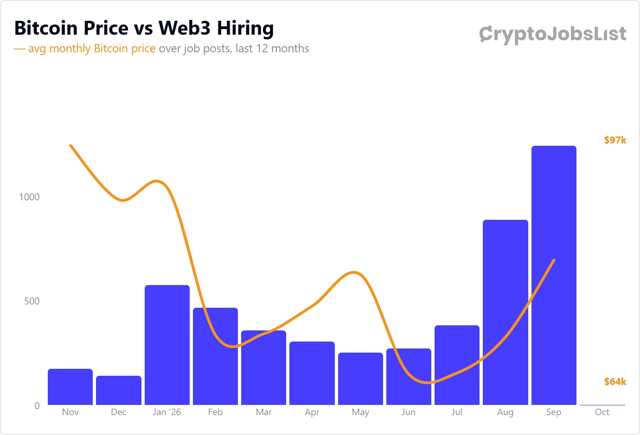
The relationship between token price speculation and hiring velocity has officially fractured. Instead of chasing bull-market hype, today's hiring trends reflect the deep, systematic integration of blockchain technology into traditional finance (TradFi).
Well-funded projects and major financial institutions are building out institutional-grade digital asset infrastructure. This isn't speculative experimentation; it’s a concerted push into stablecoin payment rails, custody solutions, and regulatory architecture by giants like BlackRock, JPMorgan, and Fidelity. Meanwhile, a Senior Data Engineer role at Blockworks is listed for $160-200k.
According to recent industry data from hiring pipelines, demand is surging across mission-critical layers:
- Compliance Technology is seeing a 40% hiring surge, signaling that companies are finally treating regulatory infrastructure as a core product feature, not an afterthought.
- Custody Infrastructure (+38%) is booming as asset managers require professional-grade security solutions.
- Security Engineering (+37%) remains non-negotiable as smart contract risks become institutional risks.
- Settlement & Payment Systems (+36%) are evolving as the direct bridge between traditional finance and crypto-native liquidity.
This architectural shift directly impacts where and how teams are built. When pension funds and asset managers enter the space, operational risk becomes a board-level concern. Engineering teams must be compliance-aware, and security talent is non-negotiable. To guarantee this level of operational resilience, companies are increasingly demanding that teams collaborate face-to-face.
The Reality of Remote Work in 2026
To understand how this affects the broader ecosystem, we can look at data compiled by Charlie Kerr, Talent Lead at Uniswap. Kerr analyzed tens of thousands of open ATS job postings to determine exactly where the job market stands.
By applying these macro-recruitment findings to current market listings, the structural divide between remote flexibility and office-centric mandates becomes starkly clear:
1. Crypto-Native Businesses (Out of 1,735 US Open Roles)
- 83% Onsite Mandate (1,440 roles): The vast majority of roles at startups founded post-COVID require a physical office footprint.
- 17% to 20% Remote Allowance (~347 roles): Fully remote roles are shrinking and are now heavily concentrated in downstream functions like Customer Experience (CX).
2. Wider US Tech Jobs (Out of 35,549 Open Roles)
- 20% Exclusive to SF or NYC (7,110 roles): Fully 1 in 5 open technology roles are geographically locked to the San Francisco Bay Area or New York City.
- 91% Elimination Rate for Remote Juniors: If you are an early-career developer demanding remote work, you have eliminated 91% of your available job pool.
- 75% Elimination Rate for Remote Seniors: Even at senior engineering levels, insisting on a remote setup eliminates three-quarters of available opportunities.
3. Pandemic Reversion Trend
The single biggest indicator of whether a job is remote or onsite is the company’s founding date. COVID-era companies (founded between 2018 and 2021) remain the most remote-friendly, with roughly 34% of their roles open to remote talent. Conversely, companies launched from 2022 onward have tightened their requirements, leaving only 20% of roles remote-eligible.
Why Institutional Crypto Partnerships and Strategy are Centered in New York
The geographic consolidation of business development (BD) and institutional strategy into Manhattan is simple: the capital runs through regulated institutions.
In the early days of Web3, deals lived wherever the builders lived. This meant San Francisco for protocol developers, Miami for conferences, and Dubai or Singapore for regulatory arbitrage. Today, the deals that drive sustainable revenue are struck with Mastercard, Citi, and major custodians.
Those executives do not live in your meme-filled Telegram group. Instead they have offices on Park Avenue, and they expect you to sit across from them in a conference room.
“The best version of crypto hires for edge, not zip code” said one BD (@hyperbulla), after just missing out on a role for this reason.
The skillset has also shifted accordingly. The old-school crypto BD hire was a community native who understood token incentives and vibes. The modern hire understands master services agreements (MSAs), term sheets, and regulatory compliance.
This evolution has left other regions, particularly Europe, in a challenging position. Despite being early to the table with comprehensive frameworks like MiCA, Europe has watched the center of venture capital and institutional execution fly straight to New York.
You can be an incredibly sharp strategist in London or Berlin, but nobody closes a nine-figure banking integration over a standard Zoom link. Crucially, this has created a functional split: Product and code remain distributed worldwide, but the handshake lives in Manhattan.
The AI Agent Squeeze and the Nomad Real Estate
Compounding the return-to-office trend is the explosive rise of AI automation, which is putting immense pressure on legacy remote roles.
According to our Web3 Workforce Report, traditional remote departments like marketing, content creation, and baseline operations are undergoing severe compression. A lean marketing team leveraging advanced LLM content pipelines and agentic automation workflows can now match the output of what used to be an entire global department.
Because routine digital tasks are easily automated or handled by hyper-efficient, AI-augmented internal teams, the classic biz dev nomad is facing an employment squeeze. Anecdotal data confirms that independent, fully remote operators are increasingly underemployed or forced to juggle multiple fragmented income streams to stay afloat.
How to Hire Talent in 2026
So what does this mean for employers and job seekers alike?
For talent requiring a 100% remote setup is becoming a premium, expensive choice. If you are early in your career, being onsite is rapidly becoming non-negotiable. However, if you are looking for flexibility, crypto remains significantly more remote-friendly than legacy big tech.
For employers the market for top-tier talent is tightening. While major firms in San Francisco and New York are driving up salaries to secure elite onsite engineers and executives, smaller teams can still use strategic remote flexibility to capture incredible talent that prefers autonomy over a commuter lifestyle.
We know the global remote dream is powerful. But the reality for the 2026 institutional era is that proximity creates leverage. Whether you're an engineer looking to break into TradFi or a founder building the next settlement rail, acknowledging this shift is the first step to staying competitive.
Whether you need to scale an elite, onsite infrastructure team in New York or source a highly specialized remote engineer, generalist hiring boards no longer cut it. Let us handle the heavy lifting, partner with the CryptoJobsList Web3 Recruitment Agency to access our elite global talent network and build a resilient team for the institutional era.